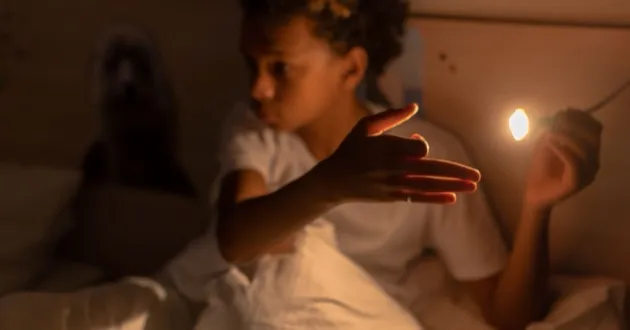
Monsters Under the Bed Are Real to Your Child: How Hypnosis Helps Kids Feel Safe at Night
The negotiation begins on schedule. The teeth are brushed, the story is read, the lights are going down — and then:
Check under the bed.
There’s nothing there, buddy.
But you didn’t LOOK.
So you look. You lift the blanket, inspect the shadow that’s definitely a jacket, and deliver the verdict: monster-free. Your child nods, settles — and twenty minutes later, padding into your hallway in socks, because the monster moved.
You’re tired of it. You’ve tried everything: the night light, the spray bottle of “monster repellent,” the firm speech about imaginary things, the exhausted snap about everyone needing to sleep.
Here’s what’s worth understanding before Halloween week arrives: your child isn’t performing. To their brain, the fear is completely real. The dark is genuinely unreadable, the imagination is genuinely running, and the part of the brain that files threats — the same one in adults — doesn’t yet check its work.
The monster is imaginary. The fear isn’t. And the difference is exactly where the fix lives.
🔗 Related: A parent’s guide to kids’ anxiety and how hypnosis helps
Why Night Fears Start (and Why They’re Developmental)
Night fears tend to arrive in a predictable window — ages 3 to 8 — for a reason:
- Imagination is now a working engine. Your child can conjure vivid scenarios, but can’t yet fully distinguish plausible from impossible. The closet could hold something — and at 7 years old, “could” is enough
- The amygdala learns before the reasoning does. Threat detection is fully online long before a child can talk themselves down from it. The fear response fires first, exactly as it will for the rest of their life
- The dark removes the evidence. Fear runs on missing information: the shadow that might move, the sound that might repeat. With vision offline, every other sense files a report
- Separation is its own project. For younger children, night = separation from you — the safest object in their universe. The monster may just be the face their separation anxiety wears
This is a phase of development, not a defect. Most children outgrow specific night fears — eventually.
But “eventually” can be two years of nightly negotiations, broken sleep for the whole household, and a child learning that bedtime is where fear lives. The developmental arc doesn’t care about the school night.
And there’s a subtler cost: dismissed fear doesn’t disappear. It goes underground. The child who learns “my fear is silly” stops reporting it — but keeps it. We’ll come back to that.
Why the Standard Playbook Fails
Parents try, in order, the following: logic, reassurance, presence, and eventual frustration. Each fails for a structural reason:
Logic answers a question the child isn’t asking. They don’t need a monster ontology — they need to feel safe, which is a body state, not a fact.
Reassurance has a half-life of minutes. It also teaches the child that safety is something you provide — meaning every night requires your re-approval. The dependency loop tightens: the more you reassure, the less capable they feel of generating calm themselves.
The night light removes some dark but introduces shadows — arguably horror’s original visual effects.
Frustration works exactly once, and the lesson learned isn’t “there’s no monster.” It’s “fear makes grown-ups leave.”
By the time families reach us, the pattern has usually calcified: parent in the doorway, child performing the checks, everyone tired — and the fear, reinforced nightly, running the household like a very small tyrant.
🔗 Related: The bedtime witching hour: when the night brings out the worst — in everyone
How Hypnosis Speaks Your Child’s Language
Here’s the insight that makes hypnosis uniquely suited to kids: children already live in the mental space hypnosis works in. They absorb stories, accept imaginative premises instantly, and enter absorbed states effortlessly. Where adults need to be talked into trance, kids walk in on their own.
A session for night fears looks far gentler than people expect:
1. The Fear Gets Told (Believed First)
Before anything is fixed, the fear is heard — on its own terms, monster included. Never argued with. A child whose monster is believed relaxes immediately, because the thing they knew was true finally got said out loud.
2. The Story Does the Work
The hypnotherapist moves into a story — custom-built around your child — where a kid just like them notices the dark, feels the flicker of fear, and discovers something different: a light inside them, a shield, a brave-place feeling that turns the shadows ordinary. The child isn’t told to be brave. They watch bravery happen to a character who is clearly them.
Beneath the story, suggestion is doing precise work: “You’ll notice the dark is just… quiet. Nothing in your room has changed. You feel warm and heavy and completely safe.”
3. The Child Gets a Tool That’s Theirs
Every kid leaves with something the fear can’t take: a button on their wrist that turns the scared feeling down, a “confidence shield” drawn during the session, a word only they know. The point isn’t magic — it’s ownership. Safety stops being something a parent must come provide and becomes something they can run themselves, at 11 p.m., alone.
4. The Monster Retires
Finally, the monster gets an ending appropriate to the child’s age — it moves on, it was never real, it was just the dark wearing a costume (fitting, this week). Crucially, the ending arrives after the fear was taken seriously, so it lands as truth rather than dismissal.
What Parents Report
Night 1-2: The checks shorten. Sometimes they stop. The most common first report is bewilderment: “He just… went to sleep. He didn’t even ask me to look.”
Week 1-2: Bedtime transitions from negotiation to routine. If the fear was tangled with separation, the 9 p.m. hallway visits fade as the child’s self-generated calm replaces your reassurance.
Weeks 3-4: The follow-up session locks the pattern in. Parents describe the child volunteering information about the dark — “it’s just my room, I know” — which tells you the new file is theirs now, not a script they’re reciting.
The long view: The child who learned their fear can be felt, expressed, and resolved — without shame — carries that sequence into the next fear. That’s the real skill being installed.
The Fear They Learn to Hide Is the One That Lasts
Every adult who sits across from a hypnotherapist for a phobia eventually traces it to a formative scene — often including the moment their own childhood fear was laughed off, dismissed, or outgrown the hard way.
Your child is telling you the fear is real while they’re still willing to say so. That’s not an inconvenience. That’s a window — with the monsters, the dark, and your trust all still in reach.
Ready to Help Your Child Sleep Without the Fear?
At Wisconsin Hypnosis Center and Apple Valley Hypnosis, we help children resolve night fears, anxiety, and bedtime dread using age-appropriate clinical hypnotherapy — gentle, story-based, and built around your child. Sessions are available in-person and online for families across Appleton, Green Bay, and Apple Valley.
Their monsters were never yours to defeat. But you can show them where the light switch is. And it starts with one conversation.
Call or Text: (920) 954-1277
Website: www.WisconsinHypnosisCenter.com
Email: hypnosisresults@gmail.com
Locations: Appleton • Green Bay • Apple Valley
Sessions available in-person and online.
Professional Guided Hypnosis and NLP helps your relationship with finances, people, physical health, emotional health, and professional skills.
Did you know we teach Hypnosis and NLP for those who want to learn these skills for your business, for your personal life — or if you’d even like to be certified and have this as your next career?
**Wisconsin Hypnosis Center – **Contact Us
**Apple Valley Hypnosis – **Contact Us