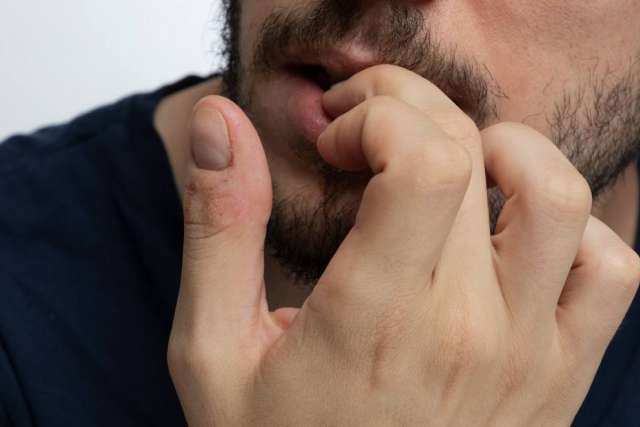
You bite your nails without thinking about it. You’re watching TV, sitting in a meeting, stuck in traffic, reading an email — and your fingers are at your mouth. You’ve tried everything: bitter nail polish, fidget toys, keeping your nails painted, wearing gloves, setting timers. Nothing works for more than a few days.
Here’s why: nail biting isn’t a nail problem. It’s not a hand problem. It’s not even a habit you can simply choose to stop. It’s a subconscious stress response that runs on autopilot — and it continues because your brain gets something from it that nothing else provides.
Hypnosis stops nail biting by addressing the actual mechanism driving it — the subconscious need it fulfills — rather than trying to willpower your way out of a deeply wired neurological pattern.
What Nail Biting Really Is
Nail biting — clinically called onychophagia — affects 20–30% of the general population. It starts in childhood (average onset age 5) and in many cases continues well into adulthood. It’s classified as a body-focused repetitive behavior (BFRB) — the same category as hair pulling (trichotillomania) and skin picking (dermatillomania).
What makes BFRBs different from regular habits:
- They’re semi-automatic — you’re often not aware you’re doing it until it’s already happening - They serve a sensory function — the physical sensation of biting, pulling, or picking provides a specific sensory feedback that your nervous system craves - They increase under stress — anxiety, boredom, frustration, and concentration all trigger the behavior - They provide temporary relief — biting creates a brief moment of calm or satisfaction, which reinforces the behavior - They cause shame — the visible damage to nails, cuticles, and fingers creates embarrassment, which paradoxically increases the stress that drives the behavior
Understanding this is crucial: nail biting isn’t about nails. It’s a self-soothing mechanism — the way your nervous system calms itself when overwhelmed. Trying to stop without replacing the soothing function is like trying to stop using a crutch without healing the leg.
Why Willpower Fails for Nail Biting
Nail biting operates on a neurological loop:
Trigger (stress, boredom, concentration) → Behavior (biting) → Reward (sensory relief, momentary calm) → Reinforcement (brain remembers: biting = relief)
This loop runs in the basal ganglia — the part of the brain that controls automatic behaviors. It’s below conscious awareness. By the time you notice you’re biting, the behavior has already been triggered and partially completed.
Willpower operates in the prefrontal cortex — the conscious, decision-making brain. It can temporarily override the automatic loop. But:
- Willpower is depletable — stress reduces it, and stress is exactly what triggers the biting - Willpower can only suppress, not replace — the underlying need for soothing remains unmet - Willpower requires constant vigilance — you’d need to monitor your hands 24/7, which is exhausting - Willpower doesn’t address the sensory craving — the nervous system still needs the feedback that biting provides
This is why every willpower-based approach eventually fails. Not because you’re weak. Because you’re fighting a neurological loop with cognitive effort — and the loop always wins when you’re tired, stressed, or distracted.
How Hypnosis Stops Nail Biting
1. Identifying the Trigger States
Hypnosis reveals the specific emotional and physical states that activate the biting loop. It might be anxiety during deadlines, boredom during passive activities, concentration during reading, or emotional overwhelm. Identifying YOUR triggers is step one.
2. Replacing the Sensory Function
The biting provides sensory feedback — pressure, texture, release. Hypnosis installs an alternative sensory anchor that provides the same nervous system soothing without the physical damage. Common alternatives include a textured ring, a stress ball, or a specific hand position that mimics the sensory pattern.
3. Breaking the Automatic Loop
Hypnosis creates awareness at the trigger point — the moment before the hand moves to the mouth. Instead of the behavior running on autopilot, there’s a moment of choice: “I notice I want to bite. What do I actually need right now?”
4. Processing the Underlying Stress
The stress that drives nail biting often has specific sources — work pressure, relationship tension, perfectionism, social anxiety. Hypnosis addresses these root causes, reducing the overall stress load that triggers the behavior.
5. Rewiring the Reward Pattern
Instead of “biting = relief,” your brain learns “biting = notice and redirect.” The old reward pattern loses its neurological priority, and the new pattern becomes the default.
What the Research Says
- A study published in the Journal of Behavior Therapy and Experimental Psychiatry found that hypnosis significantly reduced nail biting frequency, with 75% of participants showing clinically significant improvement - Research demonstrates that body-focused repetitive behaviors respond particularly well to hypnosis because they operate in the subconscious — exactly where hypnosis works - Studies show that habit reversal training combined with hypnosis produced superior results compared to habit reversal alone - A meta-analysis of hypnosis for habit control found that hypnosis was more effective than willpower-based approaches for automatic, stress-related habits - Research from the Journal of Clinical Psychology found that hypnosis for BFRBs showed lasting results months after treatment, while behavioral-only approaches showed higher relapse rates
What a Session Looks Like
Phase 1: Assessment (Sessions 1–2)
-
Mapping your biting patterns: when, where, how often, and what triggers it
-
Understanding the sensory feedback you get from biting
-
Identifying the emotional states that activate the behavior
-
Assessing damage to nails, cuticles, and surrounding skin
-
Setting specific goals: stop biting entirely, or reduce to manageable levels
Phase 2: Breaking the Loop (Sessions 3–4)
-
Deep relaxation training focused on hands and mouth
-
Alternative sensory anchoring — finding the right substitute for the biting sensation
-
Building awareness of the trigger-to-action sequence
-
Post-hypnotic suggestions that interrupt the automatic loop
-
Processing underlying stress patterns that drive the behavior
Phase 3: Reinforcement (Sessions 5–6)
-
Strengthening the new response patterns
-
Real-world practice with gradual exposure to trigger situations
-
Building resilience for high-stress periods
-
Developing self-hypnosis practice for ongoing maintenance
-
Addressing any remaining emotional triggers
Most clients notice a significant reduction in nail biting within 2–3 sessions. Complete cessation typically occurs within 4–6 sessions.
Self-Hypnosis for Nail Biting
The Hand Awareness Practice
- Several times a day, deliberately look at your hands.
-
Notice their position. Are they near your mouth? Near your face?
-
If they are, move them to your lap and take three slow breaths.
-
This builds the conscious awareness that disrupts the automatic loop.
-
Within a week, you’ll start noticing your hand position without deliberately checking.
The Replacement Anchor
- Choose a small object — a textured ring, a smooth stone, or a rubber band on your wrist.
-
When you feel the urge to bite, hold or touch the object instead.
-
Focus on the sensation: the texture, the temperature, the weight.
-
Your nervous system gets the sensory feedback it craves — without the damage.
The Stress Redirect
- When you notice stress building, press your fingertips together firmly.
-
Hold for 10 seconds while breathing slowly.
-
Release. Notice the calm.
-
This redirects the nervous system’s need for oral stimulation to a hand-based calming technique.
The Hidden Cost of Nail Biting
Beyond the obvious cosmetic damage:
- Infection risk — open wounds around the nail bed can become infected - Dental damage — chronic nail biting wears down front teeth and can cause jaw problems - Permanent nail damage — years of biting can permanently alter nail shape and growth patterns - Social embarrassment — hiding your hands, avoiding handshakes, feeling self-conscious - Emotional toll — the shame cycle of “I can’t even stop biting my nails” erodes self-confidence
Nail biting is dismissed as trivial, but for the 20–30% who do it, it’s a daily source of frustration and shame. Hypnosis offers a way out that addresses the actual cause — not just the symptom.
Your Next Step
If you’ve tried bitter polish, fidget tools, willpower, and everything else — and you’re still biting your nails — it’s time to address the subconscious pattern driving the behavior.
At Wisconsin Hypnosis Center and Apple Valley Hypnosis, we help people break body-focused repetitive behaviors by retraining the neurological loops that keep them going.
Call or Text: (920) 785-8010
Website: www.WisconsinHypnosisCenter.com
Email: info@wisconsinhypnosiscenter.com
Locations: Appleton • Green Bay • Apple Valley
Sessions available in-person and online.
Professional Guided Hypnosis and NLP helps your relationship with finances, people, physical health, emotional health, and professional skills.
Did you know we teach Hypnosis and NLP for those who want to learn these skills for your business, for your personal life — or if you’d even like to be certified and have this as your next career?
**Wisconsin Hypnosis Center – **Contact Us
**Apple Valley Hypnosis – **Contact Us